
Okay, so Axon (AXON took a nosedive after hours. A 20% drop is never a goo...
2025-11-06 4 axon stock
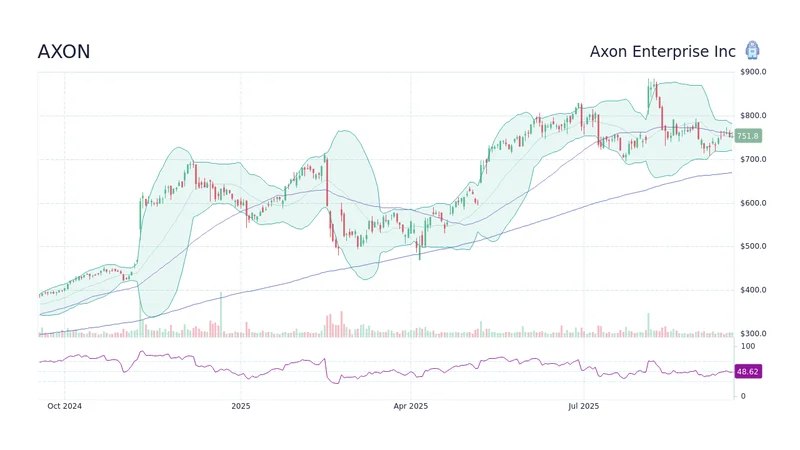
Axon Enterprise, the one-time darling of law enforcement tech, got hammered after its Q3 earnings release. The stock dropped 20% in after-hours trading. Revenue beat expectations ($711 million versus $704.8 million expected), and full-year guidance was raised. So, what gives? The devil, as always, is in the details – specifically, the earnings per share (EPS) which came in at $1.17, a significant miss against the $1.54 consensus. Axon Enterprise Plunges 20% in After Hours on Q3 Earnings Miss
The company is trying to sell us a story of software-driven growth, and the market is buying that narrative to some extent. Software & Services revenue jumped 41% year-over-year, hitting $305 million. That's solid. Connected Devices also grew, but at a slower 24%, reaching $405 million. Axon's transition toward higher-margin software and AI analytics is supposedly "taking hold." But is it, really?
Here's where the data starts to look less rosy. Operating income swung from a $24.4 million profit last year to a $2.1 million loss this quarter. GAAP net income? Negative $2.2 million, compared to a $67 million profit in the same quarter last year. Operating cash flow declined 34% to $60 million. The company blames global tariffs and heavy R&D spending.
They are pointing to adjusted EBITDA of $177 million (with a 24.9% margin) as proof that the underlying business is healthy. And the cash position is undeniably strong, doubling year-over-year to $1.42 billion. They say it’s positioning the company for M&A. Perhaps. Or is it a cushion against further profitability dips?
Management also raised full-year 2025 revenue guidance to $2.74 billion, projecting 31% annual growth. Q4 guidance forecasts revenue between $750 million and $755 million with an adjusted EBITDA margin around 24%. This assumes, of course, that tariff impacts "stabilize" and software revenue keeps accelerating.
But let's talk about that R&D spending. Axon is throwing money at AI capabilities and software infrastructure. Makes sense, given the hype around AI. But how much of that spending is actually translating into profitable revenue? I've looked at hundreds of these filings, and the sheer scale of R&D investment relative to actual profit raises a red flag. Are they chasing the AI dragon at the expense of near-term profitability? What’s the actual ROI on these massive AI investments?
The Q3 report states that total company gross margin decreased 70 basis points year over year. Excluding non-GAAP adjustments, adjusted gross margin decreased 50 basis points. They attribute this to global tariffs and increased Platform Solutions product mix, but even with the non-GAAP adjustments, the margin is still shrinking. This isn't just about external factors; it suggests a fundamental shift in their cost structure.
Axon highlights the growth in Annual Recurring Revenue (ARR), which increased 41% to $1.3 billion. Net revenue retention remained strong at 124%. Future contracted bookings grew 39% year over year to $11.4 billion. These numbers sound impressive, but let's be clear: bookings are not revenue. They are potential revenue. And a high retention rate doesn't mean much if you're not making money on those retained customers.
Looking at their supplementary non-GAAP measures, we see adjusted gross margin for Software and Services at 76.8% for Q3 2025, a slight increase from 76.3% year over year. However, the sequential decline from 78.9% in the previous quarter is concerning. Axon attributes this to professional services. But is it really just professional services, or is there something else going on?
Axon is betting big on "Axon 911," integrating Prepared and Carbyne to modernize emergency response. They claim it will cut response times from seven to ten minutes down to as little as 120 seconds. Karl Fasold, Executive Director of Orleans Parish Communications District, is quoted as saying it's a "once-in-a-generation game changer."
Okay, but let's be real. How much is this costing them? The acquisition costs were substantial (reported at $2.1 billion). And how long will it take for this investment to pay off? Axon estimates this expands their total addressable market by $5 billion, to a total of $74 billion. But addressable market is not the same as achieved market share. What percentage of that market do they realistically expect to capture, and at what cost?
They also introduced Axon Body Workforce (ABW) Mini, targeting enterprise customers in retail, healthcare, and logistics. This is their second dedicated enterprise product, expected to launch in the first half of 2026. It’s a move to diversify beyond law enforcement. But is this a distraction from their core business, or a smart expansion?
The company's balance sheet shows a large increase in cash and short-term investments. Cash and cash equivalents jumped to $1.42 billion, and short-term investments reached $952.7 million. That’s a lot of dry powder. Total liabilities also increased significantly, driven by the issuance of $1.75 billion in long-term notes. They’re borrowing heavily to fund… what, exactly? More acquisitions? More R&D? Or are they preparing for a potential downturn?
Axon's Q3 results paint a complex picture. Revenue growth is strong, and the company is making progress in its transition to a software-driven business. But the collapse in operating income and the heavy R&D spending raise serious questions about profitability. The market is clearly worried, and rightfully so. Axon needs to prove that its investments in AI and new markets will generate real returns, and quickly. The "AI story" alone won't cut it.
Tags: axon stock
Related Articles
Okay, so Axon (AXON took a nosedive after hours. A 20% drop is never a goo...
2025-11-06 4 axon stock